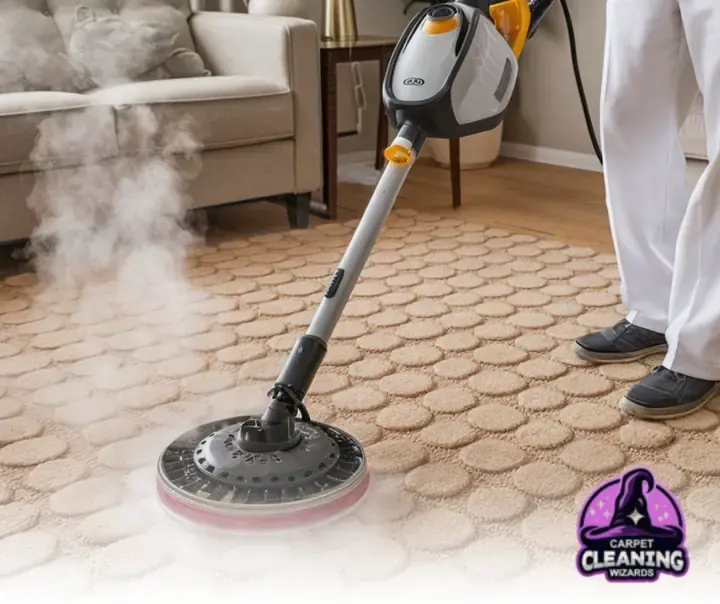
One photograph out of our own job set, and that is all it is. The file carries no town, no date, no customer and no price, so none of those appear on this page. What follows is what the frame shows and what our standard method for a tiled floor is.
What is actually in the frame
A tan floor of rounded pieces laid close together, with grout running in the channels between them. A powered head sits flat on the tile, the wand angled up to the technician holding it, vapor drifting off to the left of the picture. A sofa and a side table stand behind the work. That is the whole record.
Two things a photograph cannot settle, so we will not claim them. We are not naming the tile material. We are also not calling this an after shot. The head is down and the machine is running, so the frame was taken during the work, and no matching before frame exists.
What we did
- Cleaned the floor the way we clean every tiled floor: heat and pressure driven into the joint to break the bond between the soil and the cement.
- Extracted the released soil in the same pass, so it left the room instead of running into the next joint along.
- Worked the corners and the edges by hand. A machine head cannot sit flat there, and that is usually where the darkest grout in a room is.
- Used the same non toxic, biodegradable products we use on carpet and upholstery.
- Treated the grout as the job. The tile face is not what makes a floor look dirty.
What you should know
Glazed tile is close to non porous. Almost nothing sticks to it, and a damp cloth takes off what does. Grout is the opposite. It is porous, it is rough, and it sits lower than the face of the tile, so every liquid on that floor drains into it and stays.
Mopping is part of how it gets that way. A mop lifts soil off the tile, holds it in the bucket water, then spreads that water back across the floor, where it settles into the lowest point. Do that weekly for years and the joints fill with a concentrated version of everything that has been on the floor. That is why a floor can be mopped faithfully and still look grey.
There is also a difference between soiled grout and stained grout. Soiled grout is sound cement with dirt in its pores, and it comes back a long way. Stained grout is cement whose color has been changed, by rust, by red wine left overnight, by dye out of a wet mat. Cleaning takes away everything around the stain and the stain stays. We would rather tell you which one you have at the door than have you expect white and get beige.
The record does not say whether sealer went on afterward, so we are not saying it did. Sealer is worth a conversation once grout is clean, because it fills the pores and slows how fast the lines darken again. It does nothing for grout that is already dark, and putting it over dirty grout locks the dirt in.
When to call us
Call when the grout lines have gone a shade or two darker than the tile and mopping has stopped changing anything. The method and its limits are set out on Tile and grout cleaning. We cover eight North Jersey counties, including Essex County and Union County. There is no storefront. The van comes to the house and you get a written estimate before anything gets wet. More job photographs are on Before and after.