The honest numbers
Walkable in a couple of hours. Dry the same day. Fabric sofas 4 to 8 hours, leather faster.
Those are the figures we quote and they hold for most jobs in most houses. They are not a guarantee, and anybody who gives you a guaranteed drying time without having seen the room is guessing at four variables they have not measured.
What “dry” means, and the trap in it
There are two different states and people conflate them.
Walkable means the surface fibers have given up enough moisture that you can cross the room in socks without transferring water or picking up soil. That happens fast, often inside two hours.
Dry means the carpet, the backing and the padding have all released their moisture back into the air. That takes longer, and it is the state that matters, because moisture left in the padding is what produces a musty smell a week later.
The trap is that you cannot feel the second one. Surface fibers dry first and they are the only part your hand touches. A carpet that feels completely dry can still be holding water underneath, which is exactly why after any real water event we run equipment until the materials read dry rather than until the room feels finished.
The five things that change the number
Pile thickness. More fiber holds more water and shields what is underneath from moving air. A dense plush or a shag takes materially longer than a low commercial loop, and stairs, where the carpet wraps a nose and doubles back, are the slowest part of any job.
Temperature. Warm air holds more moisture than cold air, so a room at 22°C dries faster than the same room at 15°C. This is why the same carpet, cleaned in the same house, dries visibly slower in February.
Humidity. Air that is already near saturation cannot take much more. In a North Jersey August the outdoor air is frequently more humid than the indoor air, which produces the counterintuitive result that opening the windows can slow drying down rather than speed it up. On a humid day, air conditioning dries a room better than fresh air does.
Air movement. This is the biggest lever and the cheapest. Moving air strips the saturated layer sitting immediately above the carpet and replaces it with drier air. A single household fan pointed across a room, not down at it, across it, makes a substantial difference. Ceiling fans help. An open interior door that creates a through-draught helps more than an open window on its own.
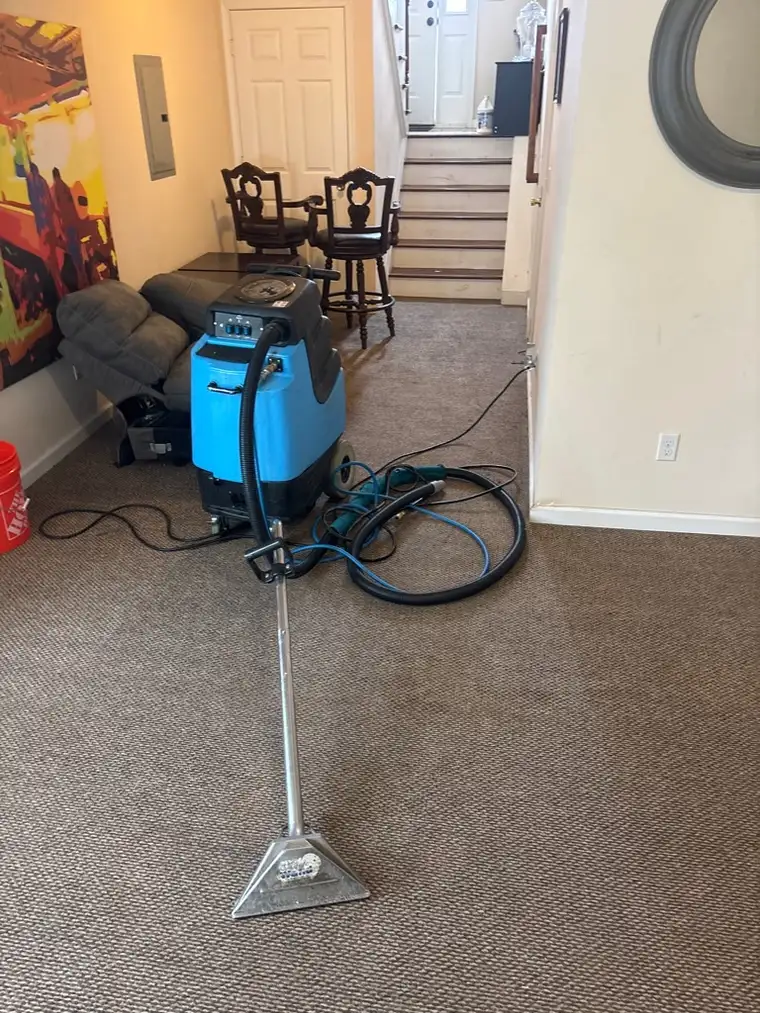
How much water went in. The controllable one, and ours. Correct extraction technique takes back out what it put in. Under-extraction, rushing the recovery pass, or a machine with tired vacuum, leaves the carpet wetter than it needs to be and turns a two-hour job into a next-morning one.
Rooms that behave differently
Below-grade basements. Cooler and more humid than the rest of the house year-round, and often with poor air exchange. Everything above applies twice. Air movers here are standard rather than optional.
Small closed apartments. A Hoboken or Jersey City apartment with one exposed wall and no through-draught has very little air exchange. The fix is mechanical: a fan and an open interior door, or the air conditioning running.
Rooms full of furniture. Anything sitting on damp carpet blocks air from reaching it, and anything with a wooden or metal foot can transfer a mark into the damp pile. That is why we put protective tabs under feet and put furniture back last.
How to speed it up
In rough order of effect:
- Move air across the floor. Fans pointed horizontally, not down. If you own one box fan, this is the single best thing you can do.
- Open interior doors so there is somewhere for the moist air to go.
- Run the air conditioning on a humid day, or the heating on a cold one. Both dry air; on a humid summer day the AC beats an open window.
- Ask for air movers. We carry them. If a room has to be usable by a specific time, a rental handover, a nursery, guests arriving, say so when you book and they come with us.
- Keep off it anyway. Walking on damp carpet in shoes puts soil straight back into a pile that is open and receptive.
What not to do
Do not crank the heat with the windows shut. You will make the air warm and saturated, and warm saturated air dries nothing. Heat plus air exchange works; heat alone does not.
Do not put the furniture back early. Foot marks and, in older pieces, wood stain transferring into damp fiber are both permanent-looking and entirely avoidable.
Do not walk from a damp room straight onto a dry one. Damp feet carry soil into the carpet you just paid to have cleaned.
When drying time is the whole job
Everything above is about a routine clean. After a leak or a flood it stops being a convenience and becomes the service itself. Wet materials given a few days of warmth grow mold, and the first day or two decides whether carpet and padding can be saved or have to come out.
That is a different process, extraction, then air movers and dehumidifiers running for days, then a check that the materials actually read dry rather than feel dry. If water has got into a floor, the useful thing to know is that waiting until Monday is the decision that costs the floor.
The one-line version
Two hours to walk on, same day to dry, longer in a cold or humid or closed-up room, and a fan pointed sideways across the floor is worth more than anything else you can do about it.