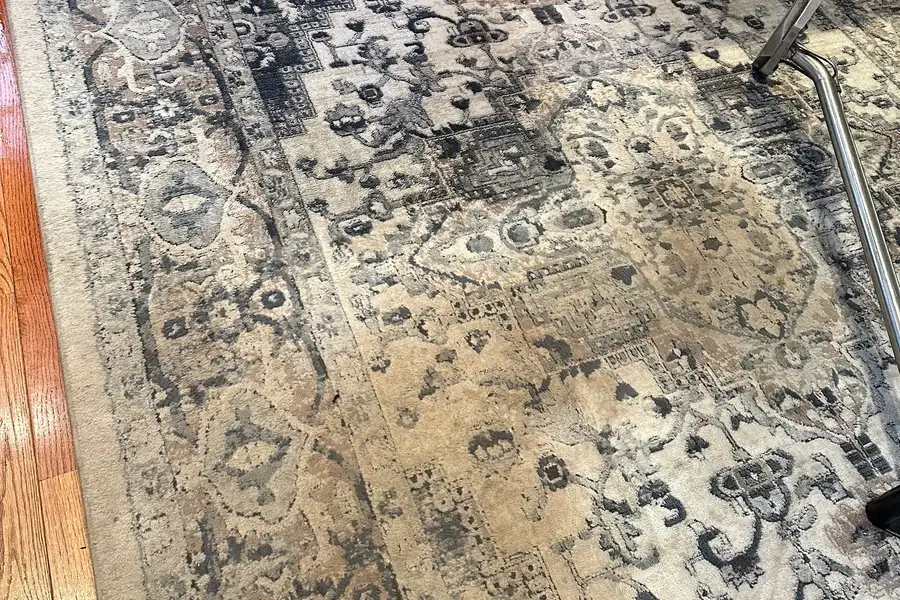
People describe it the same way on the phone. The reds have gone brownish, the cream ground looks like weak tea, and the pattern no longer reads across the room. The word they reach for is faded.
Real fading happens. But most of the rugs we get called about are holding dust down between the fibers, and dust dulls color in a way that is easy to mistake for lost dye. Which one you have decides whether cleaning fixes it.
Hold the rug up and hit it
The fastest test costs nothing and takes two minutes. Get the rug upright, strike the back, and watch what comes off it in the light.
- Vacuum it first, both sides if it is light enough to flip, so what comes out next is the deep material.
- Take it outside, or hold it over a floor you are willing to sweep. A driveway on a still day is ideal.
- Hang it over a rail or have somebody hold it upright, back facing you.
- Strike the back with a flat palm or the flat of a broom. The back, not the pile face.
- Stand where the light crosses in front of the rug. A dust cloud shows against a dark background or in low sun and is nearly invisible in flat shade.
The cloud is your answer. A vacuumed rug that still throws a grey haze is holding dust the vacuum never reached, and that dust is what mutes the color. A rug that gives you almost nothing has a different problem.
What a layer of dust does to color
A dyed wool fiber gives you color because light goes in, the dye absorbs most of the wavelengths, and what comes back out is the color you see. That only works if the light reaches the fiber.
Dust sits in the way. It is mostly mineral, ground fine, grey or tan, and not one flat sheet. It is millions of separate particles resting on the fibers and packed into the spaces between them. Light hits those particles first and scatters in every direction, so a share of what reaches your eye never touched the dye. That share comes back as a pale wash with no color in it.
Mix a pale wash into any color and the color moves toward grey. Two things happen at once. Every color reads less saturated, and the contrast between the dark outline and the light ground drops, so the pattern loses its edges. From the doorway, that is what fading looks like.
Wool hides all of this. Its scaled, crimped fiber holds dry soil without the rug looking dirty.
Three checks that separate dust from real fading
All three can be done in daylight, without moving anything.
- Part the pile and look at the base of the fibers. On a dusty rug the color down there is deeper than at the tips, which are what you have been seeing through the dust. On a sun faded rug the color is gone the whole way down, because ultraviolet light broke the dye.
- Look at where the dull area sits. Dust follows feet, so it is worst in the walkways and along the edges a vacuum never reaches. Sun fading follows the window and often has a sharp line at the edge of a shadow.
- Rub a damp white cloth across the pile. Grey or brown on the cloth means soil. A clean cloth over an area that still looks pale means the dye changed.
| What you check | Dusty | Actually faded |
|---|---|---|
| Base of the pile | Deeper color than the tips | Color gone all the way down |
| Where it shows | Walkways and edges | Where the sun lands |
| Damp white cloth | Grey or brown | Clean |
| Feel at the base | Gritty | Clean, tips can feel dry |
| What cleaning does | Color comes back | Nothing brings the dye back |
The grit at the base is the part that costs you money
Dust on top of the pile is a cosmetic problem. Grit at the base is a mechanical one, which is why we tell people to clean rugs on a schedule instead of waiting for the rug to look bad. Every 6 to 12 months suits a rug in use, at the short end for a hallway runner or a rug inside an entry door.
What gets tracked into a North Jersey house is sand, road grit and winter salt residue. It is hard and angular. Once it reaches the base of the pile, every step presses the fibers onto it and drags them across it, so the surface gets scratched and the tips start to split.
Scratched fiber dulls a rug the same way dust does, by scattering light off a rough surface instead of a smooth dyed one. That dullness survives cleaning, because the change is in the fiber and not on it.
The grit works through to the floor as well. Lift a rug that has been down two years and the hardwood under it is duller than the boards on either side. So the floor gets cleaned during the visit, while the rug dries.
How the dust actually comes out
The order matters more than the machine does.
- Identify the fiber. The back of a rug says in about ten seconds whether it is hand knotted, hand tufted or machine made, and the pile tells wool from viscose. Everything after this depends on that answer.
- Test the dyes. A little solution goes onto a white cloth pressed into the pile in a corner nobody looks at. If color transfers, the method changes: less moisture, faster extraction, sometimes a different product. Deep red beside a cream ground is the classic risk.
- Take the dry soil out before any water. Skip this and you turn dust into mud at the base of the pile.
- Hot water extraction at the settings the fiber will take. Wool is a protein and needs mild, near neutral chemistry, not the alkaline products that are fine on synthetic carpet.
- Fringes by hand. They are usually cotton even when the rug is wool, so they go grey while the rug still looks fine.
- The floor underneath, then drying. Most area rugs are dry inside a day, and shag takes longer.
Nothing gets added along the way. No dye, no color, nothing painted on. The pattern that comes back was under the dust the whole time.
What cleaning will not bring back
Better said before you book than after we arrive. Sunlight that has broken down the dye is permanent. Bleach, whether from a household product or a spot treatment somebody tried first, has taken the color out and nothing puts it back. Urine on wool is its own case, because urine is alkaline and attacks the dye bond, so an old accident can leave a patch where the dye has already changed. We lift the stain and the odor there, and the color that has gone stays gone. Pile worn flat in a traffic lane is finished too. If your rug is one of these, we say so on the phone or at the estimate.
When to call us
Call if your rug threw a cloud, if the base of the pile is darker than the tips, or if it feels gritty at the roots. Those are all fixable. Call quickly for a pet accident on wool, because that one is a clock.
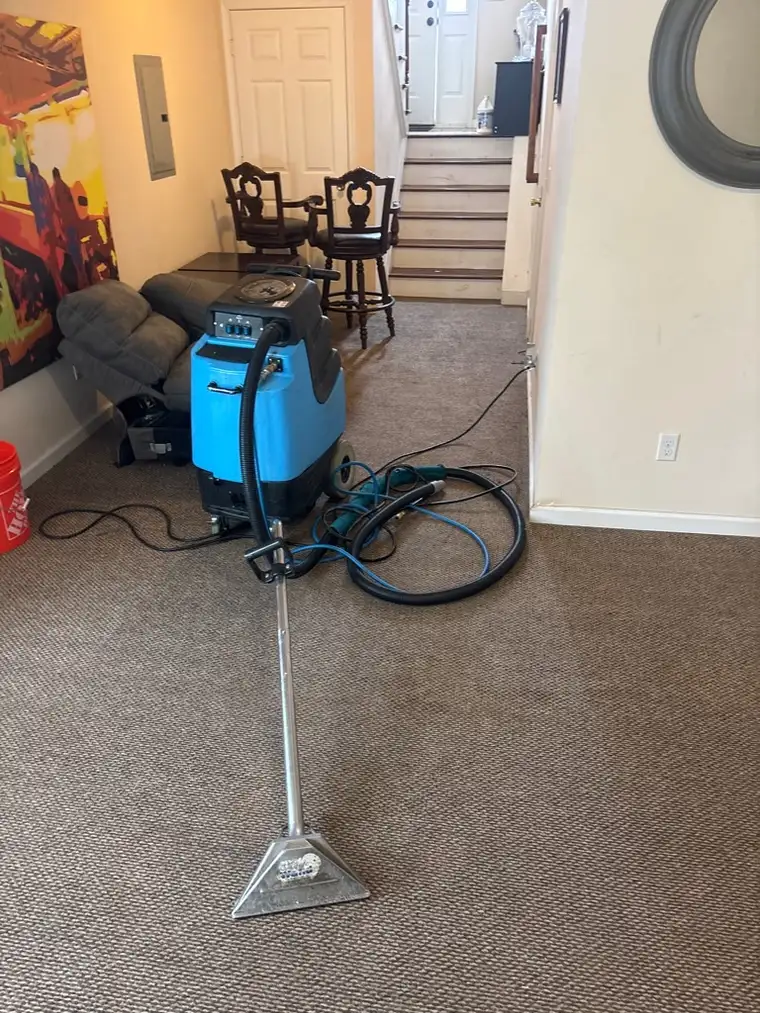
We clean rugs in the house. Nothing gets taken away, the van comes to you, and the floor under the rug is cleaned while the rug dries. You get a written estimate first. For the background on fiber and dye, read why wool and oriental rugs are not cleaned like carpet, or see the page on area and oriental rug cleaning. We cover eight North Jersey counties, including Bergen County and Essex County. Phone (908) 545-9387, by appointment 24 hours a day.