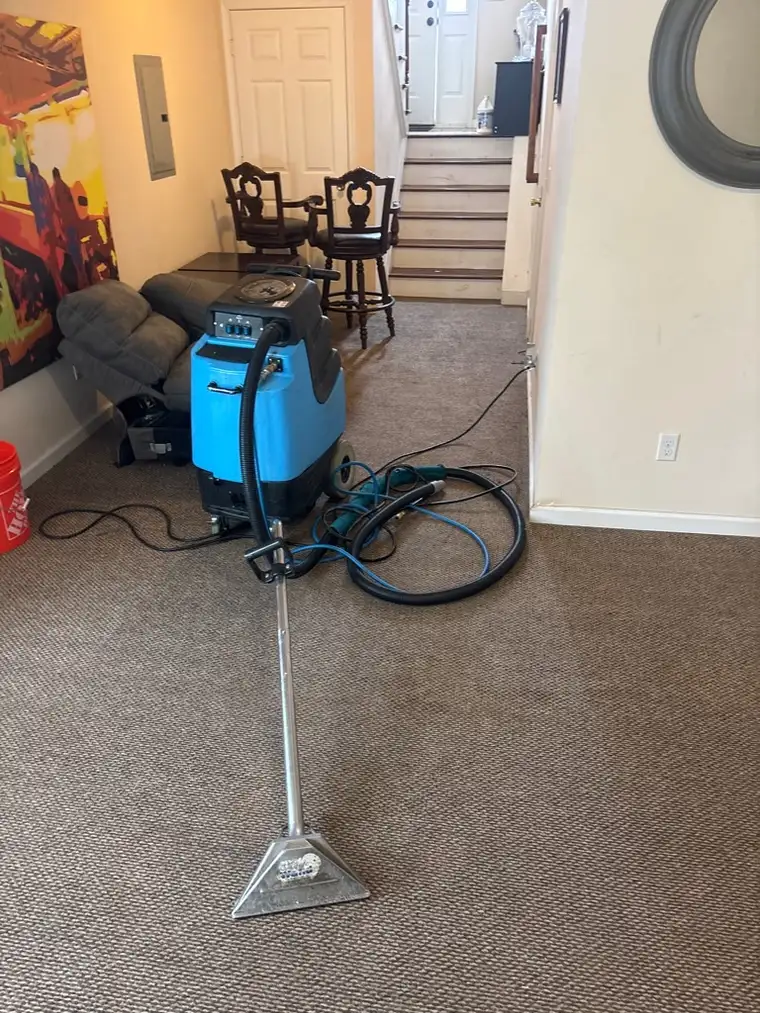
Most people find the spot hours after it happened, and the first question is whether the rug is ruined. Usually it is not. What decides that is how long the urine sat in the wool and how far it went down, which makes this one of the few cleaning problems where calling the same day changes the outcome.
Why wool is on a clock and synthetic carpet is not
Wool is a protein fiber, chemically closer to hair than to nylon, and it does not tolerate alkaline chemistry. Fresh urine is not far from neutral. Left in the pile, bacteria break the urea down, ammonia forms and the pH climbs. Now an alkaline solution is sitting against a protein fiber and a dye that was set to hold under different conditions.
That is behind both things owners notice later. The smell comes from the bacterial breakdown rather than from the urine itself. The color change shows up as a red going brown or a cream ground yellowing along the edge of the spot. The smell is reversible. The dye shift often is not.
Warmth and moisture speed all of it up, so a spot in a closed room in August moves faster than the same spot in a cold hallway in February. Synthetic wall to wall carpet is more forgiving, since nylon and polypropylene take heat and moderately alkaline products without complaint. On wool the fiber itself is part of what you are racing.
The first ten minutes, if you are standing over it now
- Blot with a white towel, pressing straight down. Do not rub. Rubbing pushes urine deeper into the foundation and distorts the pile.
- Keep going with dry sections until the towel stops picking anything up. On a large spot, stand a book on it and let it pull for a few minutes.
- Use cool water, not hot. Heat sets both the stain and the odor into a protein fiber.
- Leave the ammonia based cleaners alone. Ammonia is the wrong direction on wool, and to a dog it smells like a reason to use the same place again.
- Skip oxygen bleach and anything promising whitening. On an older wool rug those take the color out in the shape of the puddle.
- If the rug is on hardwood, lift it and get something waterproof under the wet area.
- Call while the spot is still damp. That call decides what is possible.
The home remedies are not useless. A cool water blot does real work. What none of them reach is the foundation of the rug, and none take out the salts left once the water has gone. Those salts pull moisture from the air, which is why a spot treated at home often feels damp again on a humid day.
A rug on a wood floor is two problems, not one
Urine goes through a rug. The pile holds only so much and a hand knotted piece has no waterproof backing, so the puddle spreads and keeps going into whatever is underneath.
On hardwood that means the finish first and then the boards. On tile it means the grout lines, which are porous and hold odor well. A rug can be cleaned properly and still smell a week later, because by then the smell is in the floor rather than in the rug.
Both get handled on the same visit. The rug is cleaned, and while it dries the floor underneath is cleaned. That is standard on every rug job, because grit works through the pile and dulls the boards even when nothing was spilled there.
Where the finish under the spot is already marked, that is a refinishing job rather than a cleaning one, and we will say so rather than scrub at it.
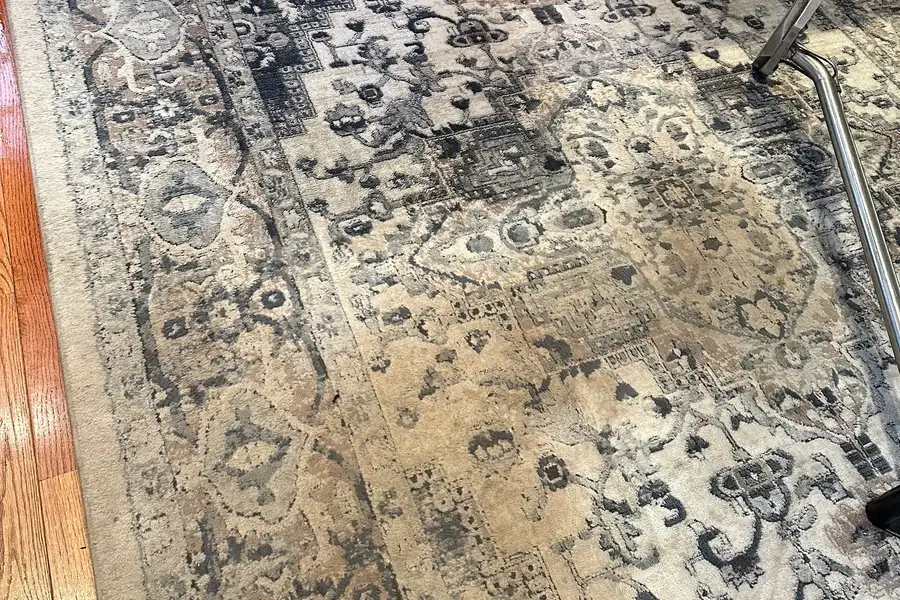
What happens when the van arrives
There is no storefront and nothing to drop off. The van comes to you and the rug is cleaned where it lies.
- The fiber is identified from the back of the rug. Hand knotted, hand tufted or machine made, and wool, cotton, synthetic or viscose. Each takes a different amount of water.
- The dyes are tested in a hidden corner, usually under where the sofa sits. Solution on a white cloth, pressed into the pile. If color transfers, the method changes first.
- You get a written estimate before work starts, with an honest read on what will lift and what will not.
- The contaminated area is flushed and extracted. Extraction is the half that matters, because what goes in comes back out with what it released.
- Odor is treated at the depth it reached rather than sprayed over the top.
- The floor under the rug is cleaned while the rug dries, and air movers go on where the room is needed sooner.
The products are non toxic and biodegradable, which matters here because the animal that caused the problem will be back on that rug the same day. Carpet is walkable in about two hours. A rug takes longer, and a shag or high pile rug longer still.
When the smell goes and the color does not
Odor removal is mostly a question of reach. Get to the contamination, flush it, extract it, and the smell goes and stays gone. Dye is different. Once alkaline breakdown has changed a dye, the color has moved and no cleaning puts it back. Cleaning takes the soil off the spot, which sometimes makes the mark easier to see, because everything around it got brighter.
The marks that tend to stay are a yellow halo on a cream ground, a red gone dull in a patch, and a pale bleached area where the dye is no longer there. Fringes are usually cotton even on a wool rug, and a fringe end that has taken repeated accidents often stays grey after the rest comes back.
Two other cases are worth naming. Hand tufted rugs are held together with latex adhesive, so they cannot be flooded. Viscose, sold as art silk or bamboo silk, marks permanently from plain water, so an accident on viscose is damage limitation from the start.
| The situation | What we usually see |
|---|---|
| Found and cleaned within a day | Stain and odor normally come out, with no change to the color. |
| Found after a week or two | Odor normally comes out. Some color change is possible. |
| Repeated accidents in one spot | Odor can usually be removed. Dye damage there is often permanent. |
| Soaked through onto hardwood | Rug and floor both need treating. The finish may already be marked. |
Two of these jobs, in the customers' words
Why the same spot keeps getting used
A dog goes back because the place still smells like somewhere to go, and a dog finds what nobody in the house can. A partial clean leaves enough behind to keep that spot marked on the animal's map of the room.
So treat the contamination at the depth it reached, and keep the animal off until the area is fully dry, because damp invites a repeat. If accidents are still happening every week, the rug is the second problem to solve, not the first.
There is more on where odor hides and why it returns in our piece on pet odor in carpet, and more on fiber, dye and construction in the one on wool and oriental rugs.
When to call us
Call as soon as you find it, and if it is the middle of the night, call anyway, because we book 24 hours a day by appointment. Send a photo and you will get a straight answer on what is likely to lift. The fiber test and the rest of the method are on the area and oriental rug cleaning page, and the Union County and Essex County pages list the towns we cover. The number is (908) 545-9387.