Four variables, and they all change with the rug
Cleaning anything textile comes down to four things you control: how much water, what pH the solution is, how much heat, and how much mechanical agitation. Get them right for the material and you remove soil. Get them wrong and you remove color, strength or shape.
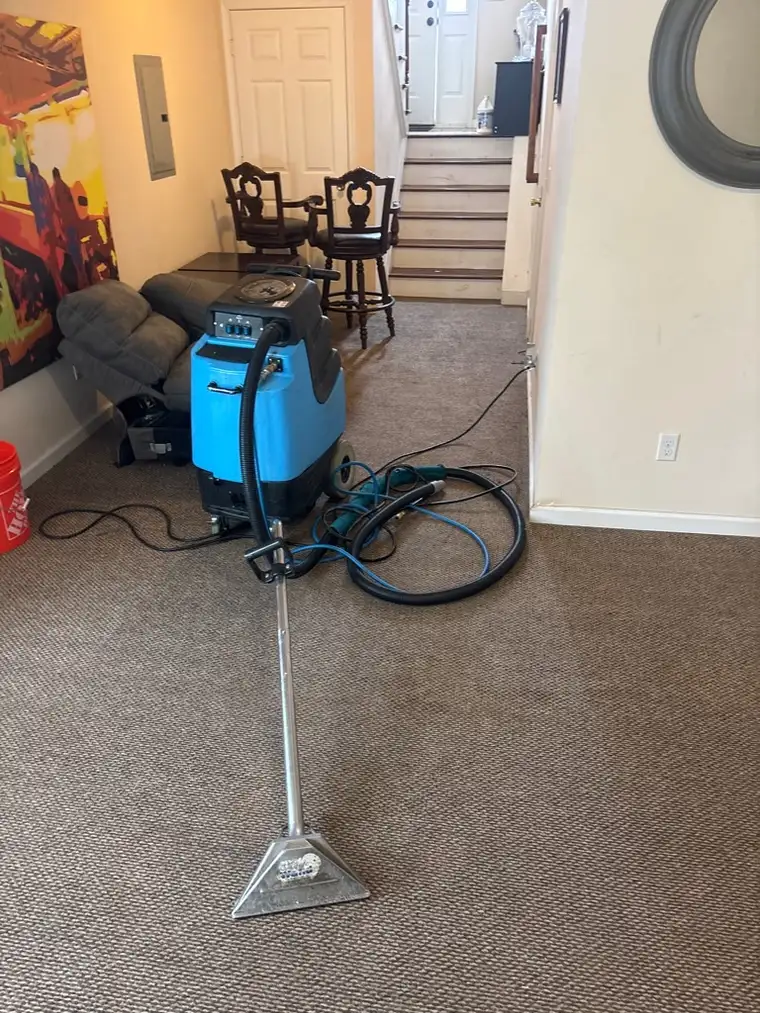
Wall-to-wall carpet in a house is nearly always a synthetic, nylon, polyester, polypropylene, with a synthetic backing. Those fibers are forgiving. They take heat, they take moderately alkaline chemistry, and they take a lot of water, which is why hot-water extraction is the standard method.
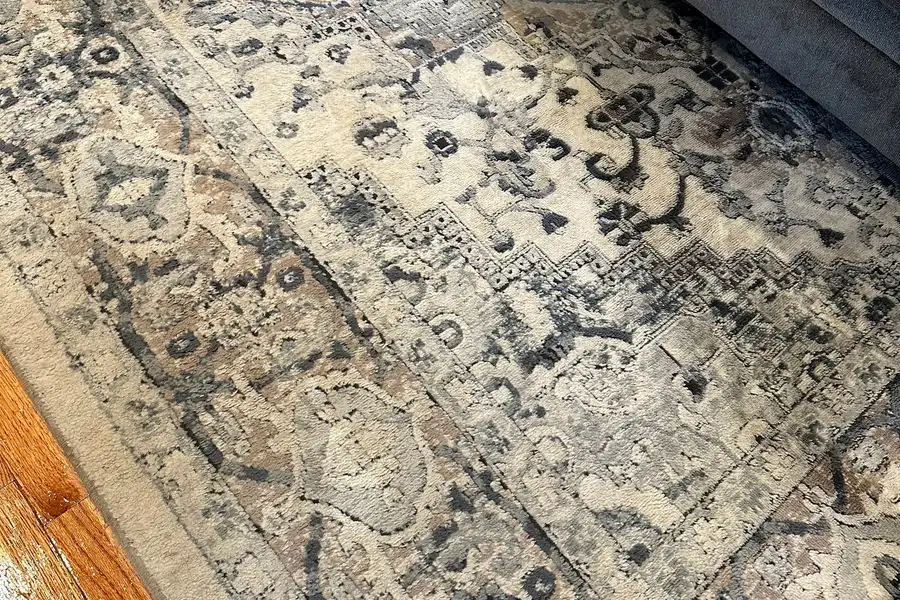
Rugs are a different population entirely, and the four settings that are correct for the hallway carpet can be actively destructive on the rug lying on top of it.
Look at the back
You cannot identify a rug reliably from the front. The back tells you almost everything in about ten seconds.
Hand-knotted. The pattern appears on the back as clearly as on the front, made of individual knots, usually slightly irregular. These are the pieces with real value, usually wool, sometimes with silk highlights, and they need the most care.
Hand-tufted. A fabric backing is glued on, hiding everything. The glue is the weak point: too much water and the latex breaks down, which produces both delamination and a distinctive smell people describe as wet dog. Hand-tufted rugs cannot be soaked.
Machine-made. A uniform, mechanical grid on the back with no irregularity. Usually synthetic, usually robust, usually straightforward.
Then feel the pile. Wool has a slight spring and a dry, faintly waxy handle. Viscose feels cool and silky and looks a bit too shiny for what the rug cost.
Wool is a protein, and that decides the chemistry
Wool is chemically closer to hair than to nylon. Two consequences matter.
It hates alkaline solutions. Most general carpet detergents sit on the alkaline side, which is fine on nylon and damaging to wool, it degrades the fiber and can shift the dye. Wool needs mild, near-neutral or slightly acidic chemistry.
It reacts to urine badly and quickly. Urine is alkaline and it attacks the dye bond directly. This is why a pet accident on a wool rug is genuinely urgent: the longer it sits, the more likely the color is permanently changed rather than merely stained. Cleaning removes the stain; it does not restore a dye that has already been destroyed.
Wool also holds a great deal of dry soil without looking dirty, often a significant proportion of its own weight, which is why a rug that looks acceptable can produce a startling amount of grit when it is properly cleaned.
Viscose: the one that catches everybody out
Sold as art silk, banana silk, bamboo silk, rayon or viscose. It looks spectacular in a showroom, has a sheen close to real silk, and costs a fraction of it.
It is regenerated cellulose, and it loses a large share of its strength when wet. Plain water can leave a permanent mark. A knocked-over glass, a dog bowl, a child with a beaker, any of these can leave a stain that no cleaning removes, because the fiber itself has changed where the water touched it. Rubbing a wet viscose pile can pull the fibers apart entirely and leave a fuzzy, lighter patch.
If your rug is viscose, the honest position is that it is a low-moisture-only piece, that some marks are not removable, and that anybody promising to steam clean it is either not looking or not telling you.
The dye test, and why red beside cream is the classic risk
Before anything wet touches a rug, a small amount of the intended solution goes onto a white cloth pressed into the pile in a hidden corner, under where the sofa sits, or at the fringe end. If color transfers to the cloth, the dyes are not stable.
The combination that most often fails is a saturated red or indigo next to a cream or ivory ground, which happens to describe a very large share of traditional oriental designs. When those dyes run, they run into the pale ground, and the result is a pink halo that is extremely difficult to reverse.
A rug that has been cleaned badly before is more likely to bleed, not less. Once dye has been mobilised it stays more mobile.
Fringes are a separate job
Fringes are usually cotton even when the rug is wool. Cotton soils faster, holds soil differently and greys while the rug still looks fine, so a rug can look clean and old at the same time purely because of the ends. They get cleaned separately and by hand.
They are also the most fragile part of the rug. Aggressive brushing tears them, and a torn fringe is a repair rather than a cleaning issue.
Most “faded” rugs are dusty
This is the single most common surprise. A rug that has been down for a few years holds a fine layer of dust throughout the top of the pile. Light hitting a dusty pile scatters rather than reflecting off the dyed fiber, so every color reads a shade duller and the contrast in the pattern flattens.
Remove the dust and people describe the color coming back, which is a description of dust removal, not of dye. Nothing was added. It is also the argument for cleaning rugs on a schedule rather than when they look bad, because by the time a rug looks dirty the grit at the base of the pile has been grinding against the fibers every time somebody walks across it.
And the floor underneath
Lift a rug that has been in place two years and the hardwood beneath it is rarely clean. Grit works through the pile and is ground against the finish underfoot, so the boards under a hallway runner are usually duller than the ones either side.
Cleaning the rug and putting it straight back onto that is half a job. The floor gets cleaned while the rug dries.
What to ask before booking
Three questions, and the answers tell you a lot:
- How will you identify the fiber? If the answer is not “by looking at the back and handling the pile”, keep asking.
- Will you test the dyes first, and where? There is only one right answer.
- What will you do differently if it is viscose? If the answer is “nothing”, the rug is at risk.