Almost every leather call we get is the same call. A sofa has gone flat in color and hard to the touch, and the owner wants to know whether cleaning will bring it back. Cleaning is part of the answer. On its own it is the wrong half.
Ask two questions and you already know the answer
When someone describes a tired leather sofa, we ask where it sits and whether one end looks worse than the other. The answers come back the same way nearly every time. It is near a window, or it backs onto a radiator or a heat vent. And yes, one end is worse.
That pattern is the whole story. Sunlight and dry indoor heat pull the oils out of the hide, so the panel facing the window goes first. The side against the wall still looks close to new, which is why people assume the sofa wore unevenly when it dried unevenly.
Two things happen as the oil leaves. The color flattens, so a brown that had depth reads as one dull shade. And the hide stiffens, so a seat that used to give under you feels like cardboard. Dirt makes leather look grubby. Dryness makes it look old. Most people call about the dryness and describe it as dirt.
Why cleaning on its own can make it worse
Leather cleaner does what it is meant to do. It lifts body oil, hand grease, hair product and the grey film that collects on the arms and the headrest. What it cannot do is tell the difference between oil that landed on the leather and oil that is part of the leather.
So every clean takes a little of the hide's own oil with it. On supple leather that is a fair trade and you would never notice. On leather that is already dry, the sofa comes out clean, looking flatter and feeling stiffer than before anybody touched it.
The conditioning step is not an add-on invented to raise a ticket. Clean, then condition, in the same visit. Cleaning takes off what does not belong. Conditioning puts back the flexibility and the depth of color the sun took out. One customer whose couch had gone lifeless next to a bright window told us afterwards that it looked expensive again, felt soft, and smelled like leather instead of like nothing.
Why leather dries faster than fabric
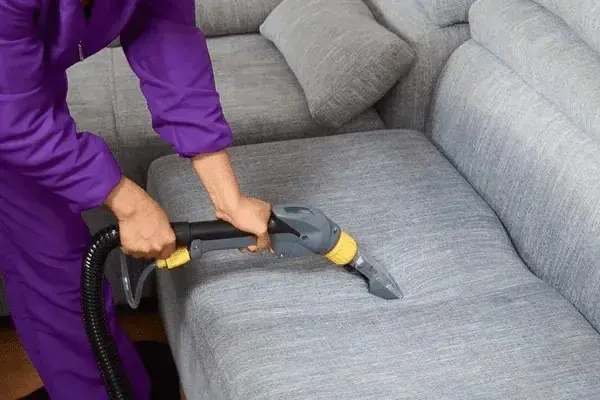
A fabric sofa is four or five materials at once: the face fabric, the thread, the foam core, the deck under the cushions and the frame. Moisture travels through the fabric into the foam, and foam holds water for days. That is why we clean fabric with a low moisture method and why a fabric sofa takes 4 to 8 hours to dry.
Leather has no equivalent problem. On finished leather the cleaning happens on a surface coating, so nothing soaks through to the padding underneath. Product goes on, soil comes off, the panel is wiped and buffed, and all that is left is a thin film of moisture on the outside. For drying time, leather is the fastest upholstery job we do.
The conditioner is the slower half, and not because it is wet. It needs time to absorb. We work it in, let it sit, then buff off the excess so you are not left sitting on a slick surface. A sofa that feels greasy when we leave was over-conditioned.
What conditioning does not do
- Cracks. Once the surface has split, conditioner softens the leather around the split and the split stays. It will look better. It will not be gone.
- Peeling. A sofa shedding thin flakes that look like paint is usually bonded leather, a backing fabric with a leather-look layer on top, and that layer is separating. Nothing we apply re-bonds it.
- Color that has already left. Sun bleaching across the top of a cushion is dye loss. Conditioning restores depth to color that is still there. It does not replace color that has gone.
- Deep scratches. A scuff can be made less obvious. A scratch through the finish into a paler layer is a repair job, not a cleaning one.
When a sofa is a repair or a recolor rather than a clean, we say so before anybody books. Telling somebody their bonded leather is not coming back is a worse conversation than taking the money, and a better one to have first.
Know what you have before you buy a bottle
Three broad groups, and they do not take the same products.
- Pigmented, sometimes sold as finished or protected leather. Most family room sofas. A colored coating sits over the hide, so it shrugs off spills and it is the most forgiving to clean.
- Aniline and semi-aniline. Dyed through with little or no coating on top, which is why it feels so good and why it marks when a wet glass goes down. It absorbs, and it dries out faster near a window.
- Bonded leather. A backing fabric with a leather-look surface. It cleans gently and it does not feed the way hide does, because there is no hide in it to feed.
The tag under a seat cushion sometimes tells you. Often it does not, and then the safe move is the one we use on every fabric piece: test an unseen area first, under the skirt or on the back panel. Learning that a product darkens your leather is survivable on the back. It is not survivable on the front.
What a leather visit looks like
- We test a hidden area first, the same dye test we run before any wet cleaning on carpet, rugs or fabric.
- The piece gets vacuumed, seams included, and the cushions come up. Grit sitting in a seam works like sandpaper on the finish every time somebody sits down.
- Cleaner goes on with a soft applicator and comes back off. The arms, the headrest and the two cushions everybody uses come first, because that is where hand grease and hair product collect.
- Conditioner goes on, gets time to absorb, then gets buffed back so the surface is soft and not slippery.
- You have a written estimate before any of that starts. The van comes to the house, there is no storefront, and nothing leaves with us.
A single leather sofa is a short visit. Plenty of people book it alongside carpet cleaning in the same appointment, and that tends to make sense: a freshly cleaned carpet under a dull sofa makes the sofa look worse than it did the day before.
Keeping it from happening again
Most of the prevention is about where the sofa sits.
- Pull it off the radiator. Even a foot of clearance changes how hard that end is being baked all winter.
- Deal with direct sun. Close the blind in the afternoon, or turn the sofa around twice a year so the same panel is not always the one in the light.
- Dust it. Dry dust works into the grain and is abrasive once it is in there.
- Clean and condition every 6 to 12 months, the same interval we give for the rest of the upholstery in a house. Go to the short end if the piece sits in sun or in the path of forced hot air.
Leather that gets fed never reaches the cardboard stage. The worst sofas we see are rarely the oldest. They are the ones that spent every summer in a bay window with nothing put back into them.
When to call us
If your leather has gone dull and stiff and the surface is still intact, cleaning and conditioning is the right job. If it is cracked, peeling or bleached, call anyway and describe it, or send a photograph of the worst patch. We will tell you what cleaning will and will not achieve before anybody books.
We cover eight counties in North Jersey and everything is done in your home. The service page is at Sofa and upholstery cleaning, with coverage details at Bergen County and Union County. Appointments are booked 24 hours a day on (908) 545-9387, and the estimate is written down before the work starts.