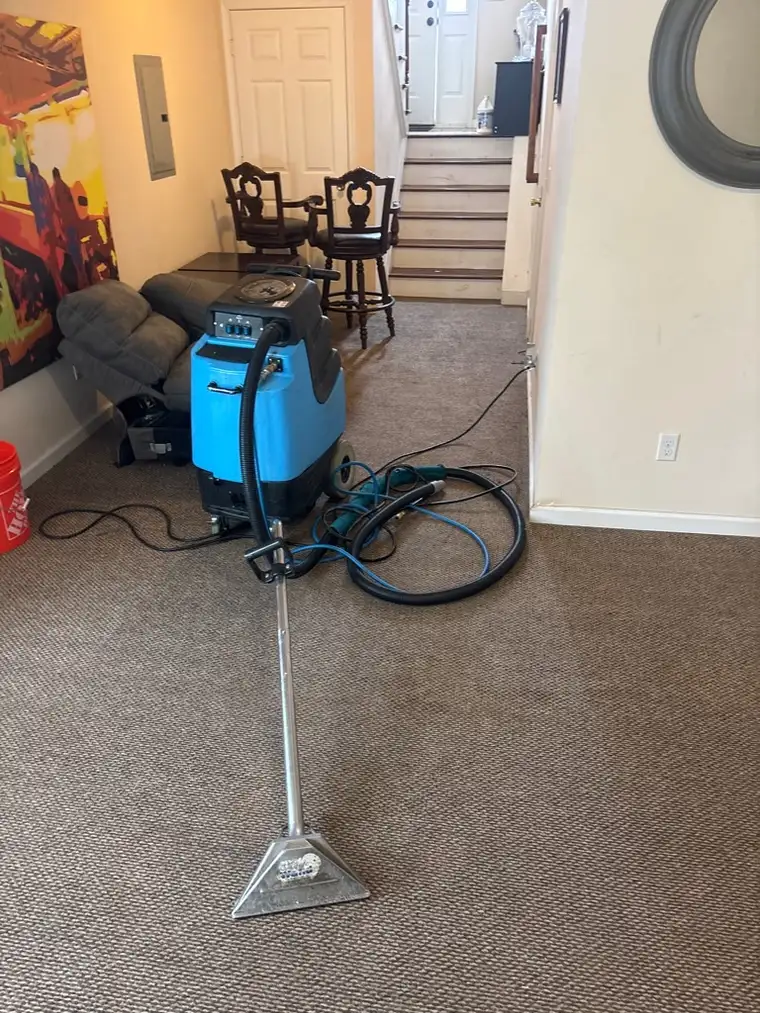
From standing height, a carpet that has lost its dye and a carpet buried under soil look like the same problem. From a foot away they are not close. One we can fix in an afternoon. The other is permanent, and we will say so before you pay anybody.
Color that is gone against color that is hidden
Soil sits on and around the fiber. It is grey, fairly even, and heaviest where feet go. A hallway two shades darker down the middle is loaded, not worn out. Hot water extraction pushes solution down to the backing and pulls it back with the grit, and the color that was always there reappears.
Dye loss works the other way. The dye sits inside the fiber, put there when the carpet was made. Strip it out and the fiber is usually still intact and still soft, just pale, or yellow, or orange. There is nothing left to remove. Clean a bleach spot and you get a very clean bleach spot.
The white towel test
This is the check our crew does at the door. It takes under a minute, and you can do it yourself before you call.
- Wet a white towel or a white cloth with warm tap water and wring it out so it is damp rather than dripping. White matters, because the whole test is reading what comes off onto it.
- Press it into the mark and hold it there for about ten seconds. Do not scrub. Scrubbing fuzzes the fiber tips and does not change the answer.
- Twist the towel once against the pile with light pressure, then lift it straight up.
- Look at the towel first, then look back at the spot.
A towel that comes up grey, brown or tan means there is soil in the fiber and the color under it is intact. That is a cleaning job, and a straightforward one.
A towel that stays white while the spot is still lighter than the carpet around it means the dye is gone. Heat, pressure and a stronger solution change nothing, because there is nothing in that fiber left to lift.
There is a third result people do not expect. The towel picks up the color of the carpet itself, pink or blue or red. The dye is loose rather than missing. That is a warning about method, not about the stain, and it is why we test the dyes in a hidden corner before any moisture touches a rug. A bleeding border is the one mistake in this trade that cannot be walked back.
What actually takes the color out
| Cause | What it looks like | Does cleaning bring it back |
|---|---|---|
| Chlorine bleach | White, yellow or orange marks with soft edges, often a splash or a drip line | No |
| Benzoyl peroxide, from acne cream or face wash | Pale orange patches beside the bed, on a bath mat, or on the route from the bathroom | No |
| Sunlight through a window | A wide, even, pale area with a sharp line where a sofa or rug blocked the light | No |
| Old pet urine | A yellow to orange ring that is still there after the smell is gone | No |
| Mold sprays, some toilet cleaners, peroxide spot removers | Random pale marks near a bathroom or laundry room | No |
| Ground in traffic soil | Greyer and darker, follows the walking path | Yes |
| Coffee, wine, grease, ink | Darker than the carpet, defined edge | Usually, depending on age and fiber |
Benzoyl peroxide is the one nobody expects
Acne cream, acne face wash and some body washes contain benzoyl peroxide, and it bleaches carpet the way chlorine does. It travels on hands, on a towel dropped on the floor, on a pillowcase, on the corner of a bath mat. The marks surface days or weeks later, in places that make no sense until you trace the route from the bathroom to the bed.
It is also the cause most often blamed on the cleaner. A pale spot under a film of grey traffic soil is partly camouflaged. Take the soil off the whole room and it has nothing to hide behind, so it looks new. It was there before the van pulled up, which is why we photograph the room before we start.
Sun fade has a shape you can read
Fade follows the light. It is widest where the sun lands longest, it softens across the room, and it stops dead at the edge of whatever was sitting on top of it. Slide a sofa in a south facing room and the line underneath tells you how long that furniture has been there.
The reds usually go first in the pieces we see. A beige carpet drifts grey and flat, and a red based oriental can shift toward salmon on the window side while the far half is untouched. Cleaning a faded rug still helps, because dust across the pile mutes every color, but it brings back the pattern that survives, not the one that faded.
The prevention is dull and it works. Turn area rugs a quarter turn twice a year. Close a blind on the worst window during the hours nobody is in the room. Move a chair off the same square foot occasionally, so the carpet ages at one rate instead of two.
Old urine is a color problem as well as a smell problem
Pet accidents give us two separate jobs with two separate outcomes. The odor lives in the padding and sometimes the subfloor, and it gets treated at the depth it reached rather than at the surface. Our piece on pet odor covers how that works.
The stain is a different matter. Urine that has sat in carpet for months changes as it breaks down, and it can take the dye with it. After that, the smell can come out completely and a yellow shadow stays. We say it plainly at the estimate: the room will stop smelling, the ring near the radiator will still be visible.
What is left when the color is gone
There are honest options. None of them is a cleaning, and we would rather list them than sell you a visit that cannot deliver.
- Spot dyeing is a real skill and a real trade. It is not our trade, and we will tell you when what you need is somebody who dyes.
- Move the furniture rather than the carpet. A bleach splash in the corner of a bedroom disappears under an armchair or a small runner.
- Rotate area rugs twice a year so the sun cannot draw a line down the middle of one.
- Ask an installer about a patch before you price a whole room. If there is a leftover roll in the garage, a section can sometimes be cut in.
- Replace only where you look. A faded strip behind a door is not worth a new floor. A bleached patch in the middle of a living room usually is.
Why we say it before we book, not after
One of the four things we publish about how this business runs is that we tell you what will not come out. Saying so before a booking loses us a job now and then. Saying it afterwards loses a customer, and it should.
If you are not sure which problem you have, send a photo when you call. Daylight, about three feet up, flash off, with some clean carpet in the frame for comparison. That plus the towel test usually gets you an answer over the phone.
When to call us
Call when the mark is darker than the carpet, when a whole room has gone flat and grey, when a spill is fresh, or when you want a straight read before you spend money on new flooring. We work across all eight North Jersey counties.