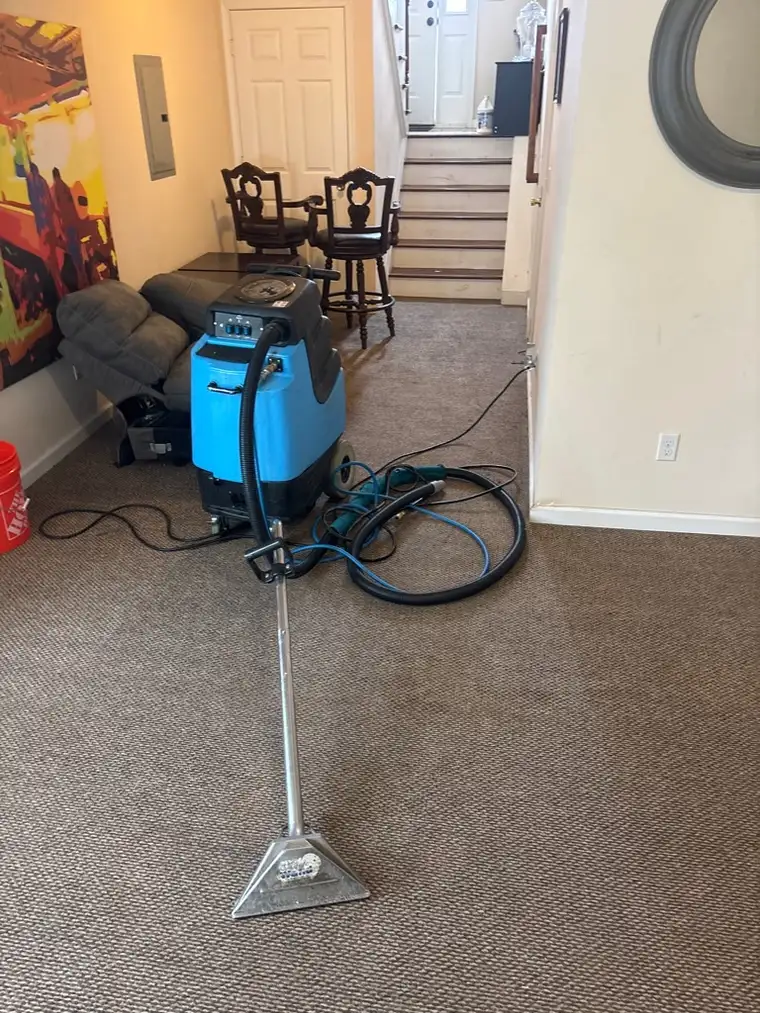
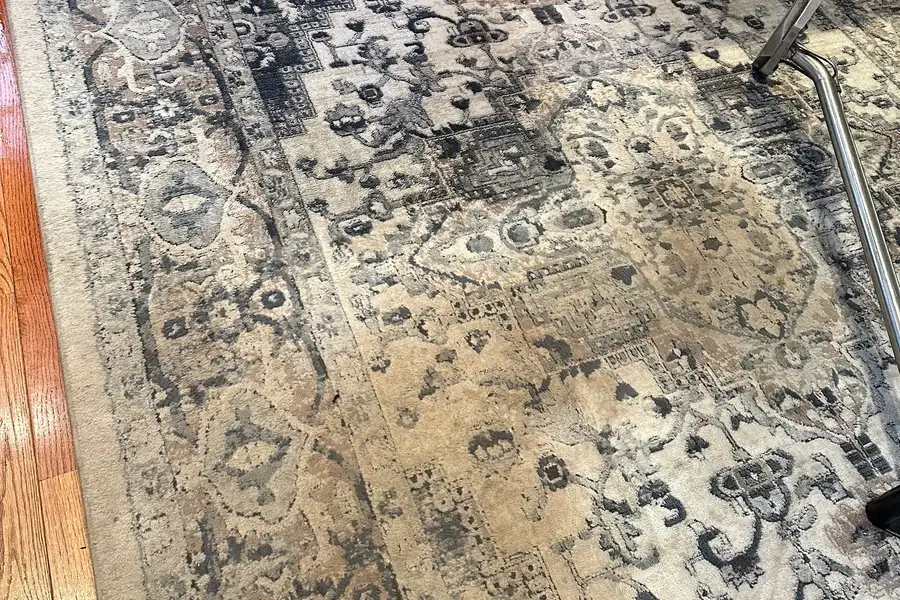
Bleeding is the one thing that can happen to a rug that cleaning cannot fix afterwards. Most problems get a second attempt. A red that has run into a cream ground does not. So the test comes first, it takes a few minutes, and it happens in front of you.
What follows is the procedure, not the theory. The fiber side of the story, wool against viscose against synthetic and why each takes a different amount of water, is covered separately.
What bleeding actually looks like
Dye leaves the fiber it was tied to and moves into the fiber beside it. On a traditional oriental pattern that almost always means a saturated red or an indigo travelling into a cream or ivory ground. What you get is a soft halo along the edge of a motif, pink where the red went, grey blue where the indigo went.
It is not a stain lying on top of the pile. The color is in the fiber now. Correcting it is a specialist job, it costs real money, and it usually only gets part of the way back. That is the whole argument for testing.
Bleeding is also a different problem from wicking, which is soil rising back to the surface as a rug dries and leaving a faint outline where a spot was cleaned. Wicking can be cleaned again. Bleeding cannot.
Where the test goes
A test patch in the middle of a rug would leave its mark in the one place everybody looks, so it goes somewhere nobody does.
- The footprint under a sofa or a heavy chair. A small damp spot there is dry and covered long before the furniture goes back.
- The fringe end, on the last inch or two of pile before the knots run out.
- The back of a folded corner, which reaches the same dyes without touching the face of the rug.
One spot is not enough. Colors in the same rug behave differently, because they were dyed separately and often at different times. A rug can be completely stable in its blue and mobile in its red. Every strong color in the pattern gets checked, and so does the pale ground, since the pale ground is what a running dye would move into.
How the cloth test is done
- A plain white cotton cloth. Nothing printed, nothing colored, so any transfer is obvious instead of a judgement call.
- The solution that is actually going to be used on the rug goes onto the cloth, not plain water. Water on its own moves very little dye. The chemistry is what mobilizes it, so testing with water gives a pass that means nothing.
- The cloth is pressed into the pile and held there. It is not rubbed. Rubbing abrades the tips of the fibers and can lift color mechanically, which gives a false reading and damages the rug at the same time.
- The cloth comes up and gets read in daylight rather than under a lamp. A faint blush counts as a transfer. The only clear pass is a cloth that comes up white on every color tested.
If you are having a rug cleaned and nobody does this, it is worth stopping to ask about before the machine goes on.
| What comes up on the cloth | What it means | What changes |
|---|---|---|
| White on every color | The dyes are stable | Normal method for the fiber, standard moisture and extraction |
| A faint blush on one color | That one dye is mobile, the others are not | Lower moisture, faster extraction, that color worked last and kept away from the pale ground |
| Clear color transfer | The dyes are unstable | Different product, minimum moisture, drying started immediately, or no wet cleaning in the home |
| Any transfer on a rug cleaned before | The dye is already mobilized | Treated as unstable no matter how light the transfer looked |
The combinations that fail most often
Deep red or indigo next to cream is the classic risk, and that describes a large share of traditional oriental designs. It is why so much of the caution around rug cleaning points straight at the rugs people care most about.
Age on its own predicts less than people expect. Plenty of old rugs carry dyes that have held for a century. Plenty of new ones do not.
The better predictor is what has already happened to the rug. A rug that was cleaned badly before is more likely to bleed, not less. Once a dye has been mobilized it stays more mobile than it started, so a past flood, an over-wetted spot clean, or a rented machine used with a household detergent all raise the risk on the next clean. If your rug has a history like that, tell us before booking. We would rather test it knowing.
What changes when a rug fails the test
A transfer on the cloth is not an automatic no. It changes the settings, and there are several to move.
- Less moisture. The pile gets damp rather than wet, so there is less liquid for dye to travel in.
- Faster extraction. Water sitting in a rug is what gives dye the time to move, so passes get shorter and more of the work goes into pulling solution back out than into putting it in.
- Different chemistry. A milder or more acidic product, because acid conditions hold many rug dyes in place better than alkaline ones do.
- Forced drying. Air movers go on straight away instead of letting the rug dry on its own schedule.
- Sequence. The pale ground gets worked first, and the wet edge is kept away from the boundary where a strong color meets it.
Sometimes the answer is still no. If dye moves badly under a light press, a living room floor is the wrong place for that rug, and we say so before booking rather than after arriving. Being told your rug should not be wet cleaned in your house is a better afternoon than a pink halo you cannot undo.
Fringes are cotton and go grey first
Fringes are usually cotton even when the rug is wool. Cotton takes soil faster and holds it differently, so the ends grey while the field still looks fine. A rug can read as old purely because of its ends.
They get cleaned separately and by hand. They are the most fragile part of the piece, and hard brushing tears them, which turns a cleaning job into a repair job.
What you can do before we arrive
- Do not test it yourself with a wet cloth if the rug might be viscose. Plain water marks that fiber permanently. If the pile looks a little too shiny for what the rug cost, leave it dry.
- Send a photo of the front and a photo of the back. The back shows the construction, the front shows which colors sit next to each other.
- Say what has happened to the rug. Spills, a flood, a leak, an earlier clean, a rented machine. All of it changes how the test gets read.
- Point out the edge lines and the fringe ends when we arrive so nothing gets missed.
When to call us
Call before the rug gets wet, not after. That includes a spill you are about to attack with a towel and a household spray, because the wrong product on a mobile dye does the damage in a single pass. We clean rugs in the house, along with the hardwood or tile underneath them, and the dye test is part of every rug visit rather than an extra.
We cover eight North Jersey counties and 228 towns. No storefront, no drop-off point. The van comes to the property and you get a written estimate before anything starts.