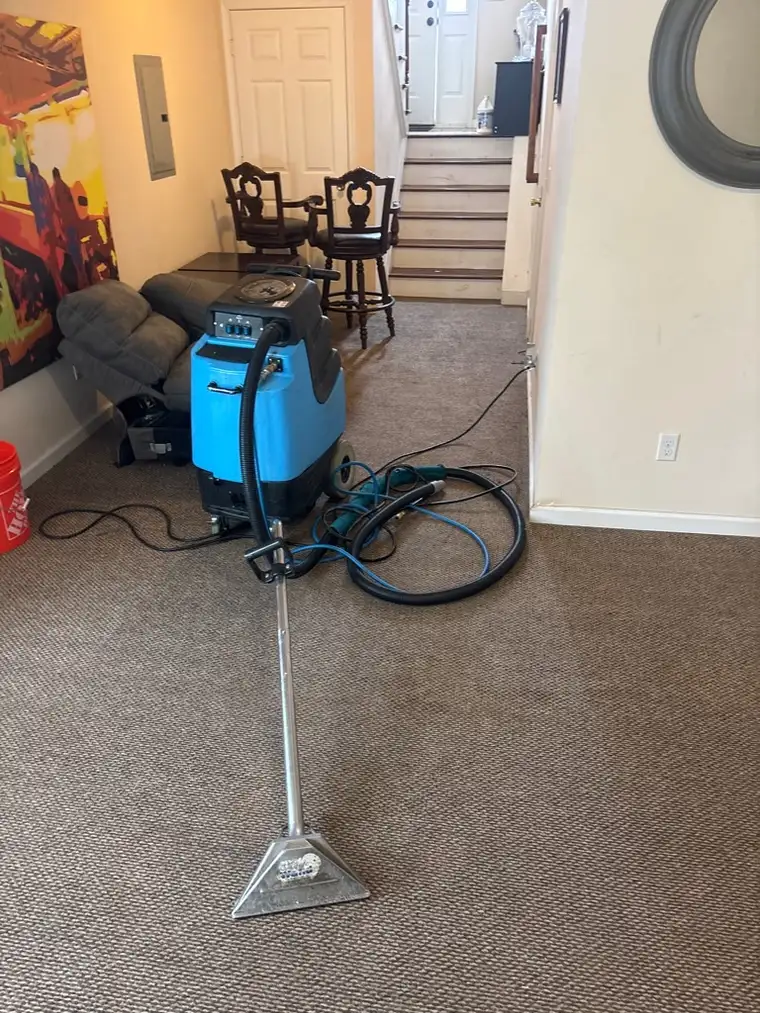
From December into March the floor inside a North Jersey front door has a different job than the rest of the house. Sidewalks and parking lots get treated, cars carry brine home on the mats, and all of it reaches your door on a boot. By February the same three things show up. A lane gone darker than the carpet either side of it, a pale crust along it, and a strip that never seems to dry. Those are one problem, not three.
Salt holds water, and that is the whole story
Road salt, and the calcium and magnesium chloride blends mixed with it, are hygroscopic. They pull moisture out of the air and hold it. Once crystals sit at the base of your carpet pile, that patch keeps drawing damp long after the boots that brought it in have dried in the closet.
Damp fiber grabs soil. Dry fiber lets grit sit loose on top where a vacuum can reach it, while damp fiber holds it against the base of the pile until it is ground in. That is why the salt lane greys faster than rooms with more foot traffic.
The crust is the same salt at the end of the cycle. When the lane dries out, the dissolved salt comes back out of solution near the surface as a chalky bloom, often with a sharp ring where the wet part stopped. The crystals are also hard and angular, and in a lane walked daily they abrade the fiber.
Why the vacuum is not solving it
A vacuum takes crystals off the fiber tips on the day they arrive, which is worth doing. It cannot reach the layer where the fibers meet the backing, and that is where salt sits within a few days of being walked on. A beater bar on a damp lane makes it worse, driving the rest down past the tips.
What to do at home the day it comes in
Salt dissolves in plain water, which is the one convenient thing about it.
- Vacuum the lane dry, slowly, in two or three directions. Fast passes skim the tips.
- Wet a white cloth with plain warm water and wring it out until it is damp, not dripping. A dyed cloth can hand its own color to wet carpet.
- Press it into the crust and hold. Lift, refold to a clean part, press again. Blot rather than rub, because rubbing fuzzes the fiber tips permanently.
- Dry it fast with a fan across the floor. A damp lane in a cold hallway with the door shut can stay wet most of a day.
Skip the detergent. It does not dissolve salt any better than water does, and what stays behind is sticky and collects soil in the same lane. Blotting handles a fresh crust. It will not empty a lane that has been taking salt since Christmas.
Two mats, doing two different jobs
One mat at the door is what almost every house has, and it is the arrangement that fails, because a single mat is being asked to scrape and to absorb at the same time.
- Outside, a coarse mat with a stiff surface, to knock crystals off the sole before the boot moves further.
- Inside, an absorbent mat, for the meltwater that survived the mat outside.
- Long rather than square. People take three or four steps clearing a doorway and a small square catches the first one.
- A boot tray with a raised lip, because boots left on carpet leave a salt ring where the mat should have been.
- Rinse the inside mat during the season, since a loaded mat hands salt back to the next wet sole.
Shoes off inside the door beats any product sold for the purpose.
Entry rugs, and the one that should not be there
A machine made synthetic rug at a front door is a good idea. It is built to be wetted and it can be rinsed properly. Wool in the same spot is different, because wool takes on moisture readily and stays damp longer. We test dyes in a hidden corner before anything wet touches a rug, and one that has sat in salted meltwater since January is exactly the kind we want tested first.
Then there is the rug lying on top of carpet at the door. It holds meltwater against the carpet underneath, which has no way to dry with a rug flat on it. When the rug comes up in March there is often a rectangle under it in worse shape than the lane beside it.
Extraction rinses salt out instead of moving it around
We clean carpet by hot water extraction. The machine pushes heated solution into the pile under pressure, and half a second later the same head pulls it back out with what it released. That matters more for salt than for ordinary soil, because salt does not break down into something harmless. It dissolves, and then it has to leave the carpet in the water it dissolved into. Anything that wets the pile without pulling the water back out has only moved your salt around.
The lane gets slow overlapping passes, because one fast pass takes the easy half and leaves the rest. Then the stairs, if the stairs start at the door, as they often do here. Each step is three surfaces, the tread, the riser and the carpeted stringer at the side, and the first treads take everything that got past the mat. Those get worked by hand.
Late winter is the visit worth booking
Clean an entry lane in January and it reloads within a few weeks, because the sidewalks are still being treated and the same boots come through the same door. The visit that holds is the one after the salting stops, usually between late February and the end of March.
Two things change that. A lane gone visibly white or gritty underfoot in midwinter should not wait, because loaded fiber is abraded every day it is walked on. The other is a house where somebody has allergies or asthma. Otherwise the usual cadence applies, every 6 to 12 months, with a hard winter entry putting the front hallway at the short end.
Drying takes longer in February than it does in July
Most carpet is walkable within a couple of hours and dry the same day, and that holds in winter, but the margin is thinner. The two things that slow drying are cold and still air, and a January hallway with the storm door shut has both. So we say which rooms to stay off and for how long before we start, and we bring air movers when a room has to be back in use that evening. More on that at How long carpet really takes to dry after a professional clean.
When to call us
A lane salted and walked on through several winters has fiber that is physically worn, and cleaning does not put the twist back into a crushed pile. Most entry lanes are loaded rather than worn, and those come back further than people expect. You will hear which one you have at the door.
Call once the salting season is winding down and book the lane, the hallway and the first flight of stairs together, since they are one problem. The method is on the carpet cleaning page at Carpet cleaning, and rugs are handled separately at Area and oriental rug cleaning because fiber and dye decide the approach. The county pages at Union County and Bergen County list the towns we cover, including Elizabeth at Union Countyelizabeth/. The van comes to the house, the estimate is written before work starts, the products are non toxic, and we book 24 hours by appointment. Phone (908) 545-9387.