
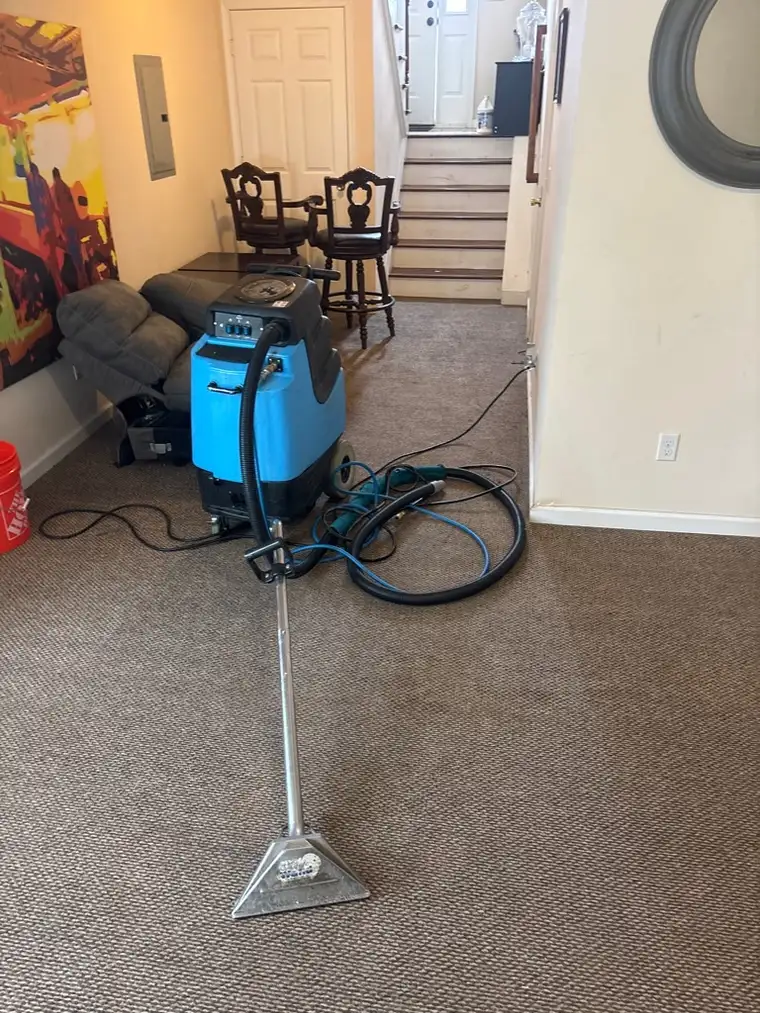
Somebody books a steam cleaning, the van pulls up, and the machine that comes out of it does not look like a steamer. The question comes up at the door often. The confusion sits in the name, not in the work.
What the two machines actually are
A hot water extractor heats water, mixes in cleaning solution, and pushes it into the carpet under pressure through a wand. On the pull stroke the same wand vacuums it straight back out into a recovery tank. There is heat, and there is visible vapor coming off a warm carpet in a cool room, which is where the word steam came from in the first place. The carpet is being flushed and rinsed, not steamed.
A true steam machine is a different tool. A vapor steamer boils a small tank of water and releases hot vapor through a nozzle. It uses very little water by design. It also has no vacuum and no recovery tank, so anything it loosens stays in the pile until someone wipes it or vacuums it later.
Both are real machines. Only one of them takes soil out of a carpet and carries it off the property.
The extraction half is the half that matters
Heat helps. Warm solution releases oily soil faster than cold, and it lets a cleaning product do its work in less time. But heat is not what cleans the carpet. Removal is.
Our short version: whatever goes into the carpet comes back out, and it brings the soil with it.
Two things follow from it. The first is residue. Cleaning solution left sitting in a pile stays tacky and collects the next round of dirt, which is the real reason some carpets look grubby again a few weeks after a clean. The carpet did not get dirty faster. It got sticky. Extraction rinses the solution back out, so there is nothing left in the pile to hold on to soil.
The second is depth. Household soil works downward and packs at the base of the pile where the fibers meet the backing, pushed there by shoes and, awkwardly for the household vacuum, by vacuuming. That packed layer is the gray strip down the middle of a hallway, and any method that only reaches the top of the pile leaves it there. Extraction gets to it because the solution is driven to the backing and then pulled back up.
Where a vapor steamer does belong
Vapor machines are not useless. They are good on hard surfaces where there is nowhere for soil to hide and a cloth can pick up what comes loose. Grout lines, sealed stone, shower fixtures, oven racks, the top of a range hood. Heat does real work on grease there.
The trouble starts when a vapor machine gets pointed at carpet or a sofa. Vapor condenses in the pile, the soil turns to slurry, and there is no vacuum to take it anywhere. It dries back down a shade darker than it started. On tile and grout we use heat too, but with extraction behind it. That visit is described at Tile and grout cleaning.
| Hot water extraction | Vapor steam machine | |
|---|---|---|
| What it puts in | Heated water with cleaning solution, under pressure | Dry vapor from a boiler, very little water |
| What it takes out | Solution and soil, into a recovery tank | Nothing. There is no vacuum |
| Where the soil goes | Off the property in the tank | Stays in the material until wiped |
| Reaches the base of the pile | Yes | No |
| Right for | Carpet, stairs, rugs, upholstery, tile and grout | Hard surfaces, grout lines, fixtures, small detail work |
| Drying | Carpet walkable in about two hours | Almost immediate, because almost nothing went in |
The warranty reason most carpet gets cleaned this way
Manufacturers of most residential carpet expect periodic hot water extraction as a condition of their warranties. It is worth reading your own paperwork rather than taking our word for it, because the interval and the wording vary by brand and by fiber.
A warranty on wear and appearance assumes the carpet is maintained the way it was designed to be. Abrasive grit at the base of the pile cuts fiber every time somebody walks on it, and only removal stops that. A method that cannot reach the grit does not satisfy the requirement, however clean the surface looks. If a claim comes up, the record that matters is a dated receipt from a cleaner who extracted.
What about the machine you rent at the supermarket
Those are extractors too. Same principle, much smaller: a pump, a wand, a recovery tank.
The differences are heat, vacuum strength and water volume. A rental unit heats less, pulls less back out, and therefore leaves more water behind in the carpet and the pad. Two problems come from that. The carpet stays wet long enough to smell, and an old pet accident or a set stain in the pad can wick back up to the surface as it dries. Over wetting is the most common thing we get called out to fix after a do it yourself weekend.
If you are using one, go easy on the detergent, make several dry passes with the trigger off for every wet pass, and put a fan on the room afterward.
How it goes in a house
There is no shop. The van comes to the house, and everything gets cleaned where it sits, including area rugs and the floor underneath them. We look at the rooms first and give you a written estimate before anything gets wet.
On anything with dye in it that we have not cleaned before, a rug in particular, we test the dyes in a hidden corner before the wand touches the visible pile. Wool and older orientals can release their own color once they are wet, and that is a thing you want to find out in a corner rather than in the middle of a room.
The products are non toxic and biodegradable and safe around family and pets. Nothing we bring in needs the windows opened afterward or the dog kept out for the day. Carpet is normally walkable in about two hours and dry the same day, and fabric upholstery takes four to eight hours. Cold weather, thick pile and a closed up room stretch that. If a room has to be usable by a set time, say so when you book and we bring air movers.
A different question from steam versus dry cleaning
So far this page has been about naming, and a vapor machine is the third thing in it.
The other question people mean by steam versus dry is a real comparison, between extraction and the low moisture methods: bonnets, compounds and foams that clean the top of a pile on a fraction of the water. Those have real uses, mostly speed of return to service and fabrics that cannot take water. We covered that trade off at Steam cleaning or dry cleaning: which one your carpet needs.
If your actual worry is how long the room is out of use, How long carpet really takes to dry after a professional clean is the more useful page. If it is a smell that comes back, Pet odor in carpet: what removes it, what only masks it explains why the padding is usually the culprit.
When to call us
Call when there is a gray lane down a hallway, when a room smells before you see anything, when a rental has to be handed back, or when it has been a year and you are due. Send a photo of the worst patch with your inquiry. It is the fastest way to get a straight answer about what will lift, before anybody books anything.
The service page for this work is Carpet cleaning. We cover eight counties, and the two we are in most often are Union County and Essex County. Booking is by appointment at any hour.