
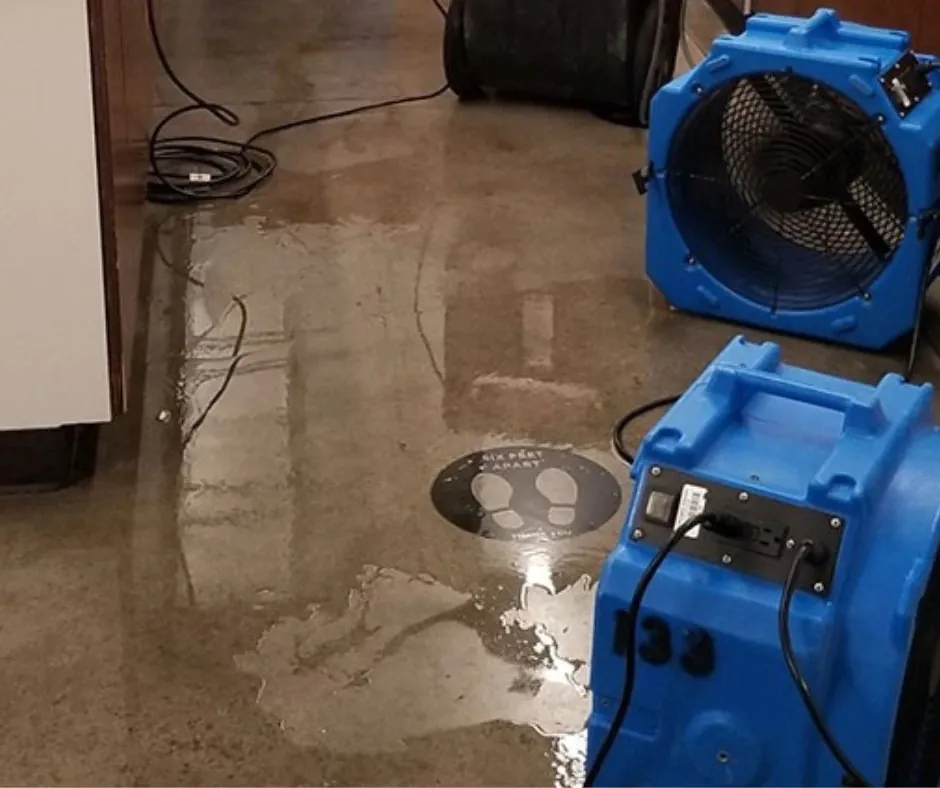
A finished basement takes water three ways. A supply line or a water heater lets go inside the house, rain finds a window well or a crack in a foundation wall, or the storm drains give up and the street comes in. The carpet looks the same in all three. What happens to it afterwards does not.
The order below is the order that keeps people safe and keeps the most floor recoverable. The first four steps are yours, and none of them needs equipment you do not have.
Power first, and the one rule about the panel
Water and a live circuit in the same room is the only part of this that can hurt you. Where water has reached an outlet, a power strip, a plugged in appliance or the bottom of the panel, shut those circuits off before you walk back into the room.
The one rule is this: do not stand in water to reach the panel. If the panel sits inside the wet area, stay out of the room and call an electrician. The Electrical Safety Foundation International is firmer about the rest than most homeowners expect. Power stays off until an electrician has inspected the system, and an appliance that has been wet is not plugged back in until an electrician says it is safe.
Stop the water, or wait for it to stop
Where the water is coming from inside the house, close the valve at the fixture, or the main shutoff where there is no local valve. Where it is coming from outside there is nothing to close. Extraction in a basement that is still taking water moves it around the room instead of out of it, so the work starts once the water stops rising.
While you wait, carry up the stairs whatever can be carried. Cardboard draws water up its sides almost at once, wooden legs stain carpet, metal feet leave rust, and a rug lying on the carpet holds water against it. Foil or a block of scrap wood under each furniture leg buys you the piece. Do not run a household vacuum over standing water.
Photograph before anything moves
Photograph the room before you carry the first box out. Wide shots of every wall, close shots of the water line, the source if you can see it, and the label on anything you expect to throw away. The Insurance Information Institute puts the same instruction first: photograph or video the damage, then take reasonable steps to protect the property from further harm.
The New Jersey Department of Banking and Insurance says it in its own words. Report the loss to your agent or insurer as soon as possible, photograph damaged property before any of it is disposed of, and keep it until it has been inspected. We handle drying and cleaning rather than insurance claims, which is why those photographs have to be yours.
Where the water came from decides the job
Category is the word the trade uses for this, and it is set by where the water started. ANSI/IICRC S500, the water damage restoration standard, sorts water into three: sanitary at the source, significantly contaminated, and grossly contaminated. Sewage, backflow from beyond a trap, seawater and water that rose out of a river or off the ground all sit in the third.
In a basement that usually resolves into one of two answers. Clean water from a line inside the house, reached early, is a drying job. Water that came up a floor drain or in off the ground is a removal job, because the contamination reaches the padding first and cleaning does not resolve it. We say which of the two a floor is in before the estimate is written.
Rain through a window well against a river in the street
Storm water is the case people assume is automatically the worst, and it is not. Rain and wind driven rain do not go straight into the third category; what matters is what the water touched on the way in. Rain through a window well onto a slab is a different problem from a river that came up the street.
Hours change the answer as well. Water that was clean on Saturday morning is no longer clean on Monday, because warmth and time have been working on it. Carpet dried inside 24 to 48 hours will in most cases not grow mold, and past that window it can. The EPA draws that line, and it is the whole reason for the hurry.
What extraction does in a basement
Extraction pulls the standing water out of the carpet and the padding, starting at the furthest edge of the wet area and working back toward the source, so the wet perimeter stops growing during the work. The dark patch you can see is smaller than the wet area, because water runs along the backing faster than it shows on the face.
Then the padding is lifted at a corner and checked. Under clean water it is often dried in place. Under anything else it comes out. The rest of the sequence, through to the last meter reading, is on the Water damage restoration page.
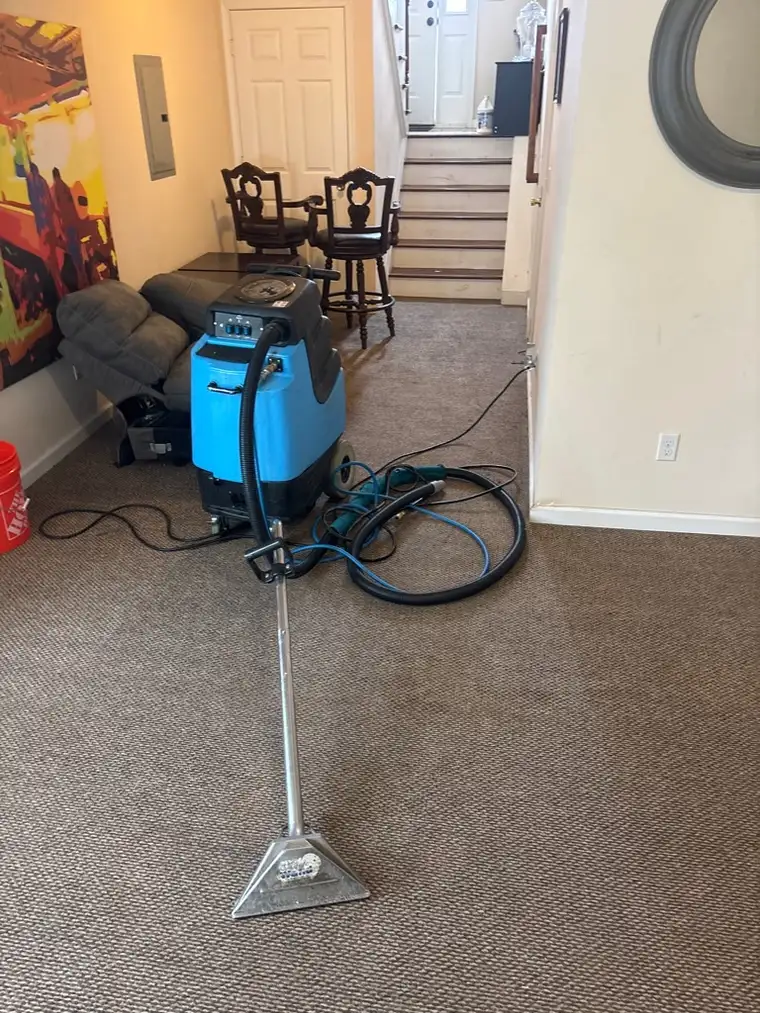
Why basement carpet dries slowest
A basement is the hardest room in a house to dry, for reasons that have little to do with the carpet. Concrete and masonry give water back more slowly than almost any material in the house, and a cold room slows things further, because warmer air carries moisture off the material faster.
Air movers push moisture out of the material and into the air, and a dehumidifier takes it out of the air rather than handing it to the next room. Fans on their own move the problem down the hallway. In a basement the equipment runs for days rather than hours, and it stays until the padding and the base of the wall read dry on a meter.
Flood cover and homeowners cover are two policies
A homeowners policy does not cover flood damage. Flood insurance is a separate policy, and the New Jersey Department of Banking and Insurance states it in those terms.
A burst pipe inside the house and water rising into the basement from outside are two different questions, so ask your agent which policy answers which. Either way, report it early and keep the damaged material until it has been looked at. Drying does not wait for any of that.
The towns where these calls cluster
Two corners of our area flood first after heavy rain. Manville sits where the Millstone meets the Raritan, and Bound Brook a few miles downstream where the Green Brook joins it. Both flooded severely in Hurricane Floyd in 1999 and again in Ida in 2021, and that corner of Somerset County is where our extraction and drying calls cluster after a storm.
The Rahway River runs through Cranford and Springfield, both of which have a long history of flooding after heavy rain, so basement work in those two towns arrives around storms rather than spread evenly through the year.
Paterson sits on the Passaic River, which winds northeast past Totowa into the city and then turns south past the Great Falls. Hurricane Irene in August 2011 brought flooding there at levels unseen for 100 years. East of it, ground floors in Hoboken and the low lying parts of Jersey City and Bayonne have a long history of taking water in heavy rain.
When to call us
Call as soon as the water has stopped rising, before you decide what to throw out. We take calls 24 hours a day by appointment, and on a basement the hour the call comes in decides how much of the floor is left to save. The estimate is written before anything starts. The county pages for Somerset County, Union County and Passaic County list the towns we cover. Phone (908) 545-9387.